
(Author’s Note: Join me as I read once more great books that I read as a teenager. I find in interesting how these books have not changed at all but I have changed greatly!)
I am an indirect product of the Great Depression. While I was born in 1949, in those optimistic postwar years, my parents grew up in those desperate years. When the American stock market collapsed in 1929 my father was 9 years old and my mother was 3. He was in south Arkansas and Mom was in north Mississippi but neither address shielded them from the poverty and distress of those years. I remember many conversations with my father about The Depression. When I asked what the word meant. His only answer was, “Son, that’s when the bottom fell out.” To this day that explanation fails to give me any details but it certainly describes the fear and the fight for survival they experienced growing up. One other story: Many years later when my family and I were living out of state we were home on a summer visit to Arkansas. Dad was feeling pretty good so we went for a drive to visit some of the towns where his dad pastored. One of this was the White River town of De Valls Bluff.
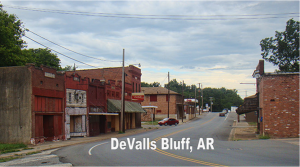
As we drove through the miniscule village, Dad pointed out an ornate little bank building which seemed to have survived all these decades without any efforts to remodel. It could have been used as a setting for a Bonny and Clyde robbery in the 1967 movie. Dad said, “That’s the bank where my father lost all his money in the Depression.” His dad was a pastor and when the Depression hit, he rented a big house and moved his whole family, married ones, too, into it and they all worked together just to survive. The Depression era survival methods robbed both of my parents of the opportunity to finish high school, debilitating circumstances which they both overcame, each in his/her own way.
In my teen years, my life was far separated from their experiences growing up. For instance, in the 1950s Dad wanted a garden in our backyard and worked hard to make it happen but neither my brother, James, nor myself would help him. Why grow your own food? Simpson’s Grocery is right there on Plaza Street and they will even deliver your groceries to your house! Witness the difference between a young mind formed in the Depression and one taking shape in the 1950’s. Like the peasants in The Good Earth, people of Mom and Dad’s generation were closer to the earth than mine.
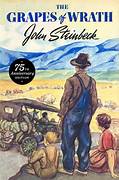
John Steinbeck’s Pulitzer Prize winning novel, The Grapes of Wrath, enabled me to understand my parents better. Steinbeck tells two stories at once, alternating between the story of the Joad family and the story of the nation itself. I remember being so impressed with this dual storytelling that many years later, when I was thinking about writing a novel based on my father’s story, I considered alternating his story with the story of our hometown of Helena, AR, and the never ending battle with the big river. I wanted to draw on the work of a columnist in the Helena World, Porter C. Young, called Taming the Mississippi, to tell my father’s story and that of my hometown in alternating chapters. I hope I get to do this someday. My novel would be called Helena Crossing.
Read about Porter. C. Young here: https://tinyurl.com/3j2px2ed
Reading The Grapes of Wrath again after all these years was an amazing experience. My Christianity is based in the Pentecostal Revival of the first half of the 20th century. I found my place in the story when Grandma Joad declares from her perch high atop the old truck the family is using to cover the 2000-mile trip from Oklahoma to California, “Praise God! I got to get out!” The characters in this story were so much like so many of the people I knew in Arkansas and Mississippi! My purpose here is not to present a synopsis of the story of the Joad family and the people they meet on this tragic journey. My purpose is to encourage contemporary readers to take this work of fiction into their hearts. “Fiction is a lie that tells the truth.” Is the message in another great pair of novels by the wonderful Rabbi, Chaim Potok, My Name Is Asher Lev, and, The Gift of Asher Lev, to which I give my highest recommendation.

Read about Chaim Potok here: https://en.wikipedia.org/wiki/Chaim_Potok
So, my fellow-reader of great books, if you want to understand the impact of the Great Depression, load up your essential belongings and strike out on a journey called, The Grapes of Wrath.
Two More Things
1.The Film.
The great director of the classical Hollywood, John Ford, brought this amazing, epic story to the screen in 1940. Henry Fonda leads a marvelous cast in this version which of necessity leaves out many details and certain language that could not be filmed in 1940.
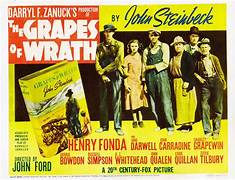
The essential story is there. It was difficult for me on this re-read to not visualize Fonda, Jane Darwell, and John Carradine as the characters they played on film. I must admit that the ending of the book could never have been put on film in those days.
2. The Title.
Where did Steinbeck get this crazy title? From a great American hymn, The Battle Hymn of the Republic, words by Julia Ward Howe:
Mine eyes have seen the glory of the coming of the Lord;
He is trampling out the vintage where the grapes of wrath are stored;
He hath loosed the fateful lightning of his terrible swift sword:
His truth is marching on.
This imagery draws upon images and metaphors from the Bible and from Christian tradition. Here is a passage from Revelation:
Revelation 14:19–20
And the angel thrust in his sickle into the earth, and gathered the vine of the earth, and cast it into the great winepress of the wrath of God. And the winepress was trodden without the city, and blood came out of the winepress, even unto the horse bridles, by the space of a thousand and six hundred furlongs.”
Here is an ancient icon:
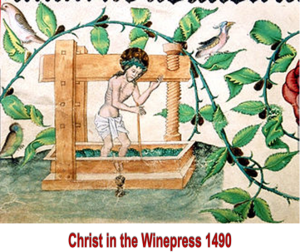
The message is that the Lord pays the price for the sins of mankind.
For more on this go to: https://en.wikipedia.org/wiki/Christ_in_the_winepress
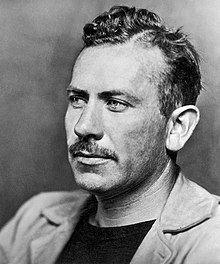
John Steinbeck, 1939
For more on the author, visit: https://en.wikipedia.org/wiki/John_Steinbeck
Semper Reformanda!
Stephen Phifer

Leave a Reply