
Mark 4:18-21
The Spirit of the Lord is upon me, because he hath anointed me to preach the gospel to the poor; he hath sent me to heal the brokenhearted, to preach deliverance to the captives, and recovering of sight to the blind, to set at liberty them that are bruised, to preach the acceptable year of the Lord. And he closed the book, and he gave it again to the minister, and sat down. And the eyes of all them that were in the synagogue were fastened on him. And he began to say unto them, this day is this scripture fulfilled in your ears.
It didn’t end well, this preaching assignment in His hometown synagogue, but that is another story. Today let us dwell on the ancient words of Isaiah that tell of the wonderful things Messiah will do among His people. I used to think of this scripture while I was leading the congregation in worship. There were precious moments when the room was filled with the power and presence of the Lord and the people had forgotten all about me, my choir and orchestra, my worship team, and the technology needed for more than a thousand worshipers to enter into the Holy Presence of Jesus. At those moments, I felt I had disappeared and gladly so. I knew that Jesus was walking the aisles of our church—this is what we built it for– touching, healing, calling, delivering, setting captives free, binding up those with broken hearts, and preparing lost folks to receive the good news.
How did it happen? How did singers and instrumentalists and technicians and songs, some old, some brand new, and just everyday people in a sanctuary, experience the power and glory of Jesus as He walked among them? Was this a rare and random miracle? No. To one degree or another, it happened in every worship service. How? Why? Because we had learned to minister to the Lord, giving Him “the glory due His name.”
Based on Psalm 29, we planned our worship by this ancient, holy, and eternally challenging standard—“The Glory Due His Name.” We did not measure our music choices by the age or style of the songs, but by their content and their intent—what was said and why. Was scripture, either as a quote or as a source, the content of the music? Were the songs “psalms, hymns, and spiritual songs?”[1] Were they skillfully put together so the music did not distract from the message?
The promises are there in the Word, expressed by the Lord Himself in His hometown synagogue when He claimed Isaiah’s prophesy would be fulfilled in His own ministry. When we learn how, as His Holy-Royal Priesthood, to minister to the Lord, He blesses us with His marvelous presence, claims the room as His Throne Room, and His authority takes charge. In fact, according to Psalm 22, He both inhabits and is enthroned upon our worship.
|
Where can we find support for this in the New Testament? In the Book of Acts, of course!
Acts 13:2
| As they ministered to the Lord, and fasted, the Holy Ghost said, Separate me Barnabas and Saul for the work whereunto I have called them. KJV | As they ministered to the Lord and fasted, the Holy Spirit said, “Now separate to Me Barnabas and Saul for the work to which I have called them.” NKJV |
The word translated as “ministered” is rooted in the term from which we derive our word, “liturgy,” in other words, the content of our worship. This parallels the ministry of the priests in the temple and the worship of the disciples.
NT:3008: leitourgeo; to be a public servant, i.e. (by analogy) to perform religious or charitable functions (worship, obey, relieve): KJV – minister. (Vine’s Dictionary)
As they “ministered to the Lord and fasted” the Lord spoke to them, most likely through the Gifts of the Spirit, telling them what to do next. This bit of leadership led to the evangelization of Europe! By ministering to the Lord, they were told what they were supposed to do for the Lord!
This is the power behind worship in Spirit and in Truth. As we minister to the Lord by praising Him in truth in the power of His Spirit, He reveals His plan for us to minister for Him in our world. In the process Jesus walks the aisles of our sanctuary with healing in His wake, peace in His words, and power in His every step.
Are we beginning to see the difference between ministering to the Lord and ministering for the Lord? Can we now see the fork in the road before us, the choice we all face every time we plan and lead worship?
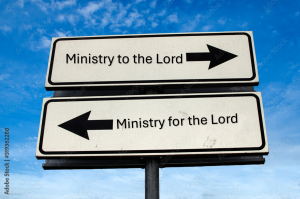
The Choice
If we choose to minister for the Lord, our hearts may be pure but our goals are earthbound. Based on the song choices that are “right” for them, we focus on the ones we want to see worship the Lord. We limit the effect of the anointing on our ministry by a mixed motive—please and reach these people and honor the Lord Jesus. Eventually this connection will wear down and so will we, all of us, leader, team, and congregation. We will run short of creativity or technology or repertoire. We can begin to serve the Lord in our own strength and be assured our human empowerment will run out. When the focus of the service is on the congregation or on us, it is guaranteed to fade.
If we choose to minister to the Lord with pure hearts, we can focus everything we say and do on “giving unto the Lord the glory due His name.” Our platform will become His Office-Place, His Throne Room. As we join the hosts of heaven, we will disappear into the blinding revelation of King Jesus! He will then walk the aisles of our sanctuary and do all those marvelous things He told His hometown synagogue about:
- to preach the gospel to the poor;
- to heal the brokenhearted,
- to preach deliverance to the captives, and
- recovering of sight to the blind,
- to set at liberty them that are bruised,
- to preach the acceptable year of the Lord.
As a worship leader, I have seen this happen time and again. When God is moving by His Spirit, I am not making it happen. I am watching it happen. The anointing of the Holy Spirit means that He does the work of the ministry using our lives. To me the essence of Spirit led and empowered worship is getting out of the Spirit’s way and watching Him do the work. We are the servants; He is the Master.
Can there be a greater difference between opposites?
Lacking this theology, we have made the tragic miscalculation of considering worship a church growth tool: “We will sing this and do this to reach them.” It is time to learn from our forebears in Acts 13 and “minister to the Lord” so we can hear the voice of the Spirit of God once again.
This is what the world needs from us!
Semper Reformanda!
Stephen Phifer
DrStevePhifer@Gmail.com
[1] These definitions are quite specific. Their meaning in the first century is what matters. See https://stevephifer.com/fire-and-form-psalms-hymns-and-spiritual-songs/


Leave a Reply