Seems like I have always been a reader. I remember in the first grade watching the students in the second grade sitting at their desks with their books open before them. Something about the way they held their books made me want to learn to read. I must have learned quickly because my next memory is reading books on my own. I loved the illustrations contained therein and depended on them to imagine the story on the movie screen of my mind. I remember so clearly the turning point when I no longer needed the illustrations. I was reading, “Bar Pilot,” an adventure novel about the challenge of the captain of a tugboat whose job it was to board ships seeking safe harbor in New Orleans and guide them to port.
[1] There was a storm scene in which the pilot had to leave the tugboat and climb a rope ladder to board the ocean-going clipper ship. The scene was so dramatic and filled with danger that it seemed to play like a movie in my mind. Suddenly I realized that I did not need an illustration; the words in the book were enough.
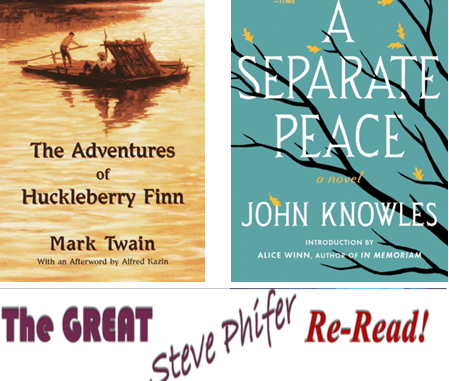
Somewhere in these early years I started reading The Adventures of Huckleberry Finn every summer. I grew up in a Mississippi River town on the Arkansas side, Helena, Arkansas. I realized that if Huck and Jim were real, they would have floated past Helena at some point of their adventure. I also read The Adventures of Tom Sawyer but I lost interest in it since it did not bear annual review. (Much later, I discovered that Mark Twain had written a tribute to Helena in another of his books.) [2]
Fast forward to the Summer of 1963. I was 13 years old when I launched my annual journey with Huck and Jim and good old Tom. However, things were different that year, as I am sure that I was different as well, with hormones beginning their journey down my life’s stream. The whole town celebrated the centennial of the Civil War Battle of Helena, July 4, 1863. There was a big parade with Confederate soldiers patrolling the streets of Helena. That same summer, the Civil Rights Movement was moving out of the deep shadows of white supremacy into the light of the evening news, and therefore, into my focus. I was a serious Christian who enjoyed playing my clarinet in worship,[3] prayed every morning as my father led our family devotions, and loved to take my Bible with me into the woods to read. So, along with Mark Twain, other writers with higher sources of inspiration fed my heart and mind. Reading “Huck Finn” that summer was a different experience all together. It was more than an adventure; it was a revelation. Although the same racial language in the novel was the normal racial terminology of the culture on the Arkansas Delta in the summer of 1963, as it had been as long as I could remember, suddenly the louder, clearer voices of the writers of Scripture were speaking in louder, clearer terms to my growing conceptions of how life should be lived. The inconsistencies of what my culture told me and what my Bible told me were beginning to get my attention. (For a more detailed account of this process, may I recommend my essay, Of Lies, Levees, and Life, Growing Up on the White Side of Jim Crow.[4])
Two scenes in Huck’s story were like huge logs adrift in the Spring flood on the old river.
- Huck has decided to abandon his “sinful” relationship with the runaway slave, Jim. His culture had convinced him that slavery was legal, even moral, and it was not only illegal but it was immoral to help a run away slave. Huck would be a “low down abolitionist” bound for a devil’s hell. He wrote a note to reveal Jim’s hiding place on the river. But his heart did not agree. He and Jim had become friends. They had saved each other’s lives! Jim’s inherent humanity was now clearly visible to Huck. To turn him in was not an option. He tore the letter up with the words, “All right, I’ll just go to hell.” My 13-year-old mind shut down my reading and opened my heart.
- At Tom’s aunt’s house in Louisiana, Huck pretends to be Tom. Since he has swum ashore from the raft, he is soaking wet so his “aunt” asked him why. He makes up a story about the boiler blowing up on the steamer throwing him overboard. She asks in supreme ignorance, “Was anybody hurt?” Huck’s answer comforted her. “No’m, killed a N______.” She takes comfort in his ironic report, “Well, that’s good. Sometimes people get hurt when that happens.” Again, I was stopped midstream. Although that book was written in the late 19th century, it described my world in the mid 20th
The use of the Nword is the primary problem with this novel. It’s use accurately describes the America in which and to which it was written and no reasonable substitute is available for it. For this reason there never has been, to my knowledge an accurate film made from this story. Several film versions have been attempted but all without success in my view. Without the subtext of equality of human beings of any color, the story degenerates into an adventure tale with no serious message. Even though he never addresses the racism in any moralistic way, the story itself condemns white supremacy. Well done, Mr. Clemens! My recommendation is to read it as it was written and let that awful, racial slur hurt your heart every time it appears on the page.
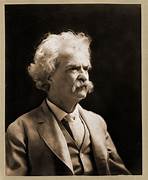
Samuel L. Clemens (Mark Twain)
https://en.wikipedia.org/wiki/Mark_Twain
______________________________

When I started my re-read of A Separate Peace immediately after reading Huck Finn, I had a startling realization. The relationship between two private school roommates in the early years of WWII reflect the relationship between Tom and Huck. Gene is the principal character and Phineas is his dynamic friend. Just as Tom loved to invent games and turn every one of them into an adventure with Huck going along for the fun, Phineas does the same and Gene can do nothing other than play along. These two teenagers represent their generation well; one is the good student and the other is the outstanding athlete. This is my father’s generation. Thank God for them! They teamed up to defeat evil around the world and provided us with a peace which, while it may be shaky, still has not collapsed.
To me this book is about the process of introspection. By that I mean, Gene is constantly examining his motives and projecting improper ones on others, even his best friend. This undeserved projection of his suspicions onto Finny’s life is the source of the tragedy in this story. While these young men are preparing to fight an external war, an internal one is raging in the heart of one of them.
Reading this as a teen, I identified with Gene, for the Christian life I was attempting to lead demanded introspection. Scriptures like, “From the abundance of the heart, the mouth speaks.” And “A good man out of the good treasure of his heart brings forth good things.”[5] turned my attention inward to my motivations and to the strong emotional drives awakening in my heart. Much later in life I would learn about projection, the process of attributing things in our hearts to the hearts of others. This is the drama of this story.
Our parents were not simply heroes or cowards, they were people who had to win the battle within even as their civilization was at war around the world. My father listened with his keen musician’s ears for German U-boats as he and his destroyer escort shipmates protected two convoys across the Atlantic. Meanwhile, my father-in-law, B.B. Woolf, served in the medical division of the army in Africa, Italy, and England, seeking to repair those whose bodies were all but destroyed in battle–heroes, each! Introspection is a necessary life skill while projection of our motives onto others is a subtle but dangerous practice. Thank you, Mr. Knowles for bringing our thoughts into the light.
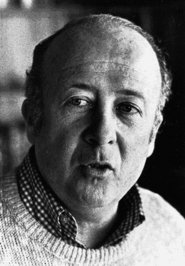
John Knowles
https://en.wikipedia.org/wiki/John_Knowles
Lessons from the practice of introspection
Living the life of a leader makes the process of self-examination of the heart an essential. It is not enough to be doing the right things; we must be doing the right things from the right motives. Two things emerge from this truth for me as a leader:
- God knows what is in my heart, even when I might be lying to myself or making puny excuses. I can be sure that the contents of my heart will be revealed to those I am trying to lead. When those motives do not align with my announced goals, the loss of credibility is one that I will not be able to overcome.
- The contents on the hearts of the people I am leading will come spilling out of their mouths. They will say good things if they have loaded their hearts with truth and destructive things if they are faking it. “From the abundance of the heart, the mouth speaks.” Along with the gift of discernment from the Holy Spirit, I can know the hearts of the people I am leading–and they will know mine!
My Dad and I used to enter talent contest with me on clarinet and him on guitar. After we had used up Just a Closer Walk with Thee, we needed another tune. The Blackwood Brothers operated out of Memphis, just a few miles upriver from Helena and one of their biggest hits was How about Your Heart? It was a distinctive tune so we used it in competition. It’s text spoke to my heart during these days of teenaged heart searching:
How about your heart? Is it right with God? Would you ask Christ in today?
Is it black with sin? or is it pure within? Would you ask Christ in to stay
People often see you as you are outside.
Jesus really knows you for he looks inside.
Friend how would you feel if your heart were made with a window on each side?
So that all could see not just outward charm but detect if inward harm.
How about your heart? Is it right with God?
That’s the thing that count today.
Words & Music: Carroll Roberson
The song was not just a pretty tune; it was a life-challenge out of which I choose not to graduate.
[1] https://www.amazon.com/Bar-Pilot-Zachary-Ball/dp/0823400042?ref_=ast_author_dp
[2] “Helena occupies one of the prettiest situations on the river.” Life on the Mississippi
[3] Some things have not changed in this rapidly rotating world!
[4] www.Stevephifer.com/of-levees-lies-and-life/
[5] Matt 12:34-35 KJV O generation of vipers, how can ye, being evil, speak good things? for out of the abundance of the heart the mouth speaketh. A good man out of the good treasure of the heart bringeth forth good things: and an evil man out of the evil treasure bringeth forth evil things.


Leave a Reply