Assessing the Results
Planning and leading worship is a demanding cycle: Plan–Prepare–Present; Plan–Prepare–Present; Plan–Prepare–Present and so on ad infinitum. On top of that, there are the annual seasons of celebration that require a whole different kind of “Plan–Prepare–Present.” When do we take time to assess our work? This too, must be a process. The lead artist in a company of artists must always be thinking ahead to the next cycle, the next ceremony, the next season while the current demands are calling us to create what is needed now. It is as if we dwell in two competing dimensions of time each with its own demands.
For these reasons and more, the goals of assessment demand our attention. We need a method. Based on my study of Scripture–what are the Lord’s purposes in our worship?–and several decades of leadership in group music making–instrumental, choral, small groups, congregations, etc.–I see four essential elements that should flow from our worship leadership:
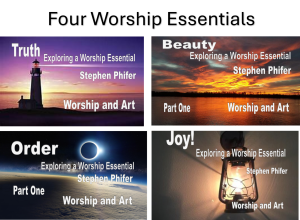
If worship leaders can routinely search the hearts of both those leading worship and those being led for these four elements, they will learn much about the real and pressing needs in the ministry.
- Our Worship must be loaded with Truth. This is the difference between Christianity and all other religions or philosophies. The Jesus Story is true! In the inspired words of Francis Schaeffer, “God Is There and He has Spoken.” Living the Christian life is not easy but it works! From a pastoral point of view the evidence is all around us. Lives changed. Chains broken. Sicknesses healed. Broken relationships restored and all in the Name of Jesus! Our testimonies are essential but worship should never be mostly about us. It can slide into narcissism if we are not careful. We must present the Lord Jesus in our worship songs. It isn’t about us–it is about HIM! We overcome the enemy by the “blood of the Lamb and the word of our testimony.” (Rev 12:11)
- Our Worship must reflect the wonders of God’s Creation. God is the author of beauty and He has placed within us the ability to recognize beauty and to create it. God has chosen the arts as the means of expression of Truth and Beauty. This is one the most important meanings of the principle of “incarnation.” Just as Jesus’ human body was formed in Mary’s womb, the Truth of the Gospel is “made flesh and dwelling among us” as holy, eternal truths are put into words, music, narrative, and image. This includes the Bible as well as our songs and confessions of worship. God created music to bring words of truth into human language accompanied by sounds that match the message: solemn, happy, reflective, inspiring, and so on. This is also true of literature, drama, dance and even carefully measured silence. The arts reflect the creative nature of God He has shared with people. This is why they are the means of worship in its fullness: private prayer, public worship, craftsmanship unto the Lord, holy living and on and on we could go. The church should be the most creative place in town!
- Our Worship must be orderly. Paul’s words for this aspect of worship are these: “Let everything be done decently and in order.” The orderliness of God’s creation is nothing less than infinite. Telescopes cannot see past the limits of His creation just as microscopes cannot see infinitesimal objects smaller than small. Even the supposed randomness in the universe is really just a level of order too small or too large or too invisible for us to detect. If then, the worship of God’s people should reflect the Glory of the Lord, it too, must be orderly. As a classically trained musician the application of “order” to the music I create or use must be both restricted by and empowered by the rules of music theory. God created music and man developed notation as a means of preserving and preparing music. Songs thrive on their structure as much as their lyrical content. Worship services and the songs within them, should flow naturally from event to event as the Spirit leads in both the preparation of the service and its presentation. We Pentecostals have learned how to be open to the “in the moment” contribution of the Holy Spirit through the Gifts of the Spirit. Oddly enough this level of flexibility requires careful planning and training. This is the context of Paul’s teaching, “Let all things be done decently and in order.” (1 Cor. 14:40) This marvelous command opens up both the planning and the presentation of public worship to the leadership of the Holy Spirit. Years ago I learned to think of worship planning as a form of prophetic time travel. I was entering into a service still days away, pausing between songs to sense what was coming next. “Decently and in order” is a prophetic dimension!
- Our Worship should be joyful. Spiritual joy–the joy we experience in the Presence of God–is not some frivolous distraction of little consequence. The Bible gives us the truth: “The Joy of the Lord is our strength.” The context of this marvelous verse is the rebuilding of the walls of Jerusalem under Nehemiah’s leadership. “Nehemiah said, “Go and enjoy choice food and sweet drinks, and send some to those who have nothing prepared. This day is holy to our Lord. Do not grieve, for the joy of the Lord is your strength.” (Neh 8:10 NIV) The wonderful thing about this strengthening joy is that it can celebrate a recent victory or with equal strength celebrate a victory yet to come. Rebuilding the walls of the city was wonderful but someone was going to have to rebuild the Temple. The Joy of the Lord found in public worship is strength for today and for tomorrow. How should we worship the Lord? Joyfully, entering His gates with thanksgiving and His courts with praise and joyful shouts. These joyful expressions and others like them strengthen us.
If these four elements are the essentials of the True Worship that Jesus told the Samaritan woman about, the worship the Father was looking for, then these should be the standards we use to assess the effects of our ministry. You can find these essays randomly scattered at my Worship Renewal Website–StevePhifer.com. The first is found here:
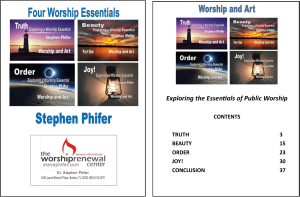
For My Fellow Worship Leaders (and for “Lead Worshipers” their Lead Pastors) I have prepared these four essays as one PDF. It is yours FREE! for the asking. Send an email to DrStevePhifer@Gmail.com.
The Worship Leader’s Desk is an important place of prayer
and preparation. Let’s meet here often!
Semper Reformanda!
Dr. Stephen Phifer

Leave a Reply